Advanced Anti-Termite Treatment & Deemak Control in Modinagar
Local Termite Control Challenges Across Modinagar
Modinagar is characterized by a dynamic urban landscape featuring historical industrial residential quarters, standalone plotted houses, highway educational enclaves, and manufacturing facilities. However, the local environmental terrain - characterized by humid subtropical plains, upper Ganga canal proximity, high summer temperatures, and historical textile industrial infrastructure - creates intense biological pressures for Termite Control. Property owners across Govindpuri, Niwari Road, Tibra Road, Delhi-Meerut Expressway corridor, Begumabad, Textile Mill Area, and SRM University enclave regularly face severe infestations requiring professional, scientific intervention rather than superficial retail sprays.
In Modinagar, subterranean termites infesting older historical industrial quarters and modern residences along the Delhi-Meerut Expressway. Because local microclimates sustain optimal temperature and moisture levels, infestations multiply rapidly if left unmanaged, quietly undermining structural safety, contaminating food, or disrupting sleep.
Structural Vulnerabilities in Modinagar Properties
Modern properties in Modinagar exhibit distinct architectural traits that pests readily exploit:
- Utility Conduits & Plumbing Chases: In high-rise towers and multi-story builder floors, vertical plumbing stacks and electrical cable conduits serve as unimpeded highways for pests traveling between floors.
- Sub-Slab & Foundation Expansion Joints: Structural settling in Modinagar creates hairline voids beneath ground-level concrete slabs where subterranean insects establish extensive colonies.
- Concealed Modular Kitchen Cavities: Modern modular kitchens provide dark, warm voids behind undermount sinks, microwave housings, and built-in appliances where insects feed and breed undisturbed.
High-Rise Societies vs Plotted Kothis: Customized Modinagar Protocols
Brightstar Pest Control tailors its treatment methodologies to match the specific housing typology of your Modinagar residence:
- High-Rise Apartments: Specialized non-fuming, odorless micro-gel baiting and localized barrier injections designed to eliminate vertical duct migration without disturbing neighbors.
- Independent Villas & Plotted Homes: Intensive structural perimeter trenching, sub-floor injection barriers, and outdoor garden buffer treatments to prevent invasions from surrounding open plots.
- Commercial & Corporate Facilities: Audit-compliant IPM frameworks aligned with ISO, FSSAI, and HACCP standards, complete with computerized inspection logs and after-hours execution.
Rapid Response & Technician Deployment in Modinagar
With dedicated local service hubs operating across Modinagar, Brightstar provides guaranteed same-day inspection and 24-hour rapid emergency response for residential societies, commercial offices, and industrial plants across Govindpuri, Niwari Road, Tibra Road, Delhi-Meerut Expressway corridor, Begumabad, Textile Mill Area, and SRM University enclave.
Comprehensive Overview of Subterranean Termite Infestations
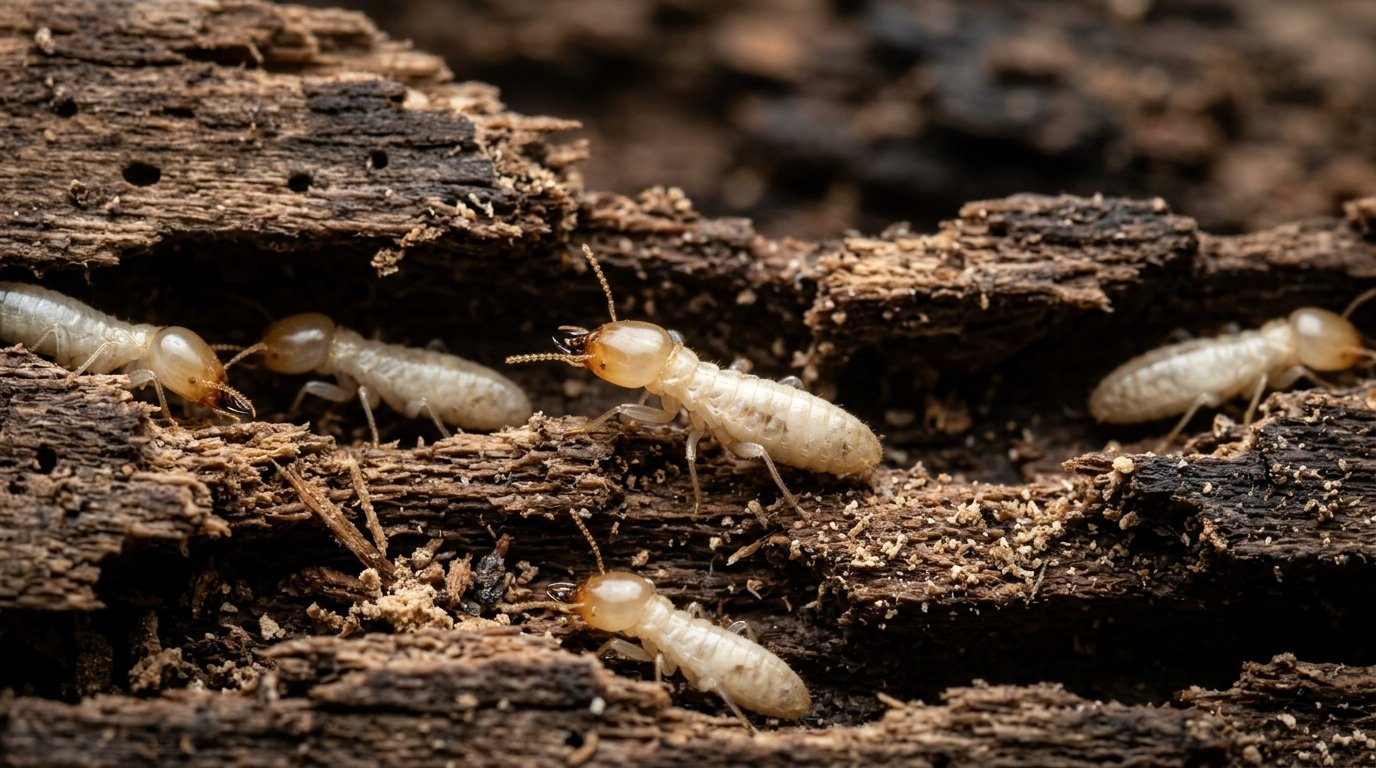
Subterranean termites (predominantly Odontotermes obesus, Coptotermes heimi, and Microtermes obesi) represent the single most destructive structural insect pest confronting homeowners, builders, and facility managers across urban and suburban environments. These wood-destroying insects dwell primarily underground in extensive subterranean colonies that can extend several meters below the foundation level, containing hundreds of thousands to multiple millions of individual workers, soldiers, and reproductive alates governed by a long-lived queen producing up to 30,000 eggs every single day.
Because subterranean termites are cryptobiotic - living entirely within concealed darkness, protected mud tubes, and the hollow interiors of wooden components - infestations remain invisible to property owners for months or even years. By the time visible surface indications emerge, such as bubbling paint, crumbling skirting boards, warped timber door jambs, or mud exploration tubes along walls, catastrophic internal structural damage has already occurred. Cellulose, the complex structural carbohydrate forming the cellular wall of timber, paper, cardboard, cotton fabrics, and architectural drywall, serves as the primary dietary fuel for termite colonies. To secure this nutrient source, subterranean termites will systematically bore through electrical PVC conduits, plaster, mortar joints, expansion foams, and flooring underlayments to access internal woodwork.
Without professional subterranean intervention, a mature termite colony can consume up to 500 grams of structural timber every week, quietly undermining load-bearing doorframes, staircases, built-in wooden cabinetry, and parquet flooring. Standard property insurance policies across India strictly exclude insect or termite damage, leaving building owners completely liable for repair bills that often reach hundreds of thousands of rupees.
Why Modern Properties are Uniquely Vulnerable to Subterranean Termites
The geographic and geological landscape across northern and central plains features fertile alluvial sandy-loam and clay soils with varying moisture strata. These underground conditions retain optimal subterranean moisture levels from seasonal monsoons, agricultural canal systems, and underground aquifers, creating ideal humidity conditions for termite colonies that require minimum 90% relative humidity within their underground nests to survive.
High-Density Residential Challenges: Apartments & Builder Floors
Modern residential architecture relies heavily on reinforced cement concrete (RCC) framed structures. While termites cannot digest concrete, RCC buildings feature structural cold joints, masonry expansion gaps, and plumbing chases where pipes penetrate concrete slabs. In high-rise residential towers and multi-story independent builder floors, subterranean termites travel vertically through damp utility shafts, electrical conduit pipes, and hairline shrinkage cracks in the foundation slab. From there, they enter residential living spaces on upper floors, attacking modular kitchens, marine-ply wardrobes, wooden flooring, and gypsum ceiling frameworks.
Furthermore, internal climate control systems (such as centralized air conditioning and winter room heating) maintain ambient indoor temperatures between 22°C and 28°C year-round. This artificial climate shields termite colonies from exterior thermal extremes, enabling subterranean foragers to feed voraciously 365 days a year without the winter dormancy observed in natural environments.
Commercial & Industrial Exposure: Warehouses, IT Parks & Factories
In commercial tech corridors and sprawling industrial logistics zones, large slab footprints settle unevenly over time, creating sub-slab voids. Unsealed construction expansion joints provide unimpeded highway conduits for subterranean foragers. Furthermore, logistics warehouses storing millions of corrugated paper cartons, wooden shipping pallets, and paper archives offer vast reservoirs of cellulose that draw subterranean colonies upward from surrounding open grounds.
Server rooms, telecommunication switchboards, and electrical distribution panels are especially attractive to termites because electrical current running through insulated wiring emits slight warmth and electromagnetic fields that termites find favorable. When foraging workers penetrate electrical junction boxes, they deposit wet soil, fecal plaster, and moisture, leading to critical insulation breakdowns, short circuits, and catastrophic server outages.
The Science Behind Brightstar’s Targeted Eradication Methodology
Conventional consumer insect sprays, surface aerosol repellents, and amateur spot treatments fail completely against subterranean termites. When a homeowner sprays an aerosol insecticide onto visible termites or breaks a mud tube, the chemical kills only a few dozen foraging workers. Crucially, older repellent chemicals emit strong chemical cues that alarm the subterranean colony. Sensing danger, the workers seal off the treated corridor and excavate new underground bypass galleries, attacking woodwork in an adjoining room or another floor. The egg-producing queen deep underground remains untouched and continues multiplying.
Brightstar Pest Control executes an advanced non-repellent transfer chemistry methodology compliant with the Bureau of Indian Standards code IS 6313 (Code of Practice for Anti-Termite Measures in Buildings). Our non-repellent termiticides (such as Imidacloprid 30.5% SC and Fipronil 2.92% EC) are completely undetectable by termites. Foraging worker termites pass freely through the treated subterranean soil and masonry barrier without alarm, coating their outer exoskeletons with the active compound. Because termites continuously groom one another, exchange predigested food (trophallaxis), and feed on deceased nestmates, the active formulation is transferred horizontally throughout the underground colony. Within 14 to 21 days, this domino cascade reaches the subterranean nursery, killing the queen and causing total colony collapse.
Step-by-Step Treatment Architecture
Brightstar Pest Control employs a rigorous four-stage post-construction anti-termite engineering protocol:
Stage 1: Comprehensive Site Audit & Acoustic/Thermal Nest Mapping
Our licensed entomologists and senior technicians conduct an exhaustive property inspection. Utilizing non-destructive digital moisture meters, borescopic fiber-optic cameras, and acoustic emission detection probes, we pinpoint active infestation pathways, locate concealed sub-floor colonies, and map structural perimeter vulnerability zones along exterior and interior walls without damaging your decorative wall finishes.
Stage 2: Precision Chemical Injection & Chemical Barrier Application (DRILL-FILL-SEAL)
To establish an uninterrupted chemical defense barrier beneath your floor slab, our technicians utilize specialized low-vibration rotary hammer drills equipped with 12mm masonry bits:
- Perimeter Skirting Injection: We drill precision 12mm holes at precise 12-inch (30 cm) intervals along the skirting line where floor tiles meet walls. Holes are drilled at a 45-degree angle to penetrate through the flooring screed down to the structural slab-soil interface.
- High-Pressure Calibrated Injection: Using high-pressure reciprocating chemical pumps fitted with specialized pressure-relief injectors, we infuse government-approved non-repellent termiticide emulsion at a controlled rate of 5 to 7.5 liters per linear meter under the slab.
- Aesthetic Color-Matched Sealing: Every drilled hole is immediately plugged with waterproof polymeric plugs and sealed with color-matched tile grout or white/grey cement, restoring the floor surface to its original aesthetic condition.
Stage 3: Sub-Colony Elimination & Woodwork Injection Treatment
While the sub-slab barrier blocks future subterranean access, active termites already trapped within structural timber must be eradicated immediately:
- Internal Timber Profiling: We inspect all embedded wooden door frames, window jambs, false ceiling framing, and wall-mounted cabinets.
- Deep Wood Infiltration: Technicians drill microscopic 4mm holes into hollowed timber sections and inject specialized oil-based or high-penetration termiticidal formulations directly into the active feeding galleries under pressure.
- Wood-Preservative Coating: Exposed unpolished wooden surfaces, wardrobe rear panels, and plumbing-adjacent plywood are brushed with non-staining timber preservatives to prevent future re-infestation.
Stage 4: Structural Sealing & Preventive Exclusion
Termites exploit expansion joints and plumbing voids. As part of our comprehensive treatment, all external perimeter joints, plumbing entry gaps, and floor-wall fissures are caulked with elastomeric polyurethane pest-exclusion sealants to permanently block subterranean insect ingress.
Quality Assurance & Safety Verification
Following service completion, our lead inspector conducts a multi-point safety verification. We verify that all drilled holes are cleanly sealed, conduct electronic VOC air-quality sweeps to ensure zero airborne pesticide residue, and provide the client with a detailed treatment layout drawing and chemical dosage certification.
Residential vs Commercial Application Protocols
Pest management requirements vary dramatically between private residences and sensitive commercial facilities. Brightstar customizes every intervention to match operational realities:
Safety Standards for Homes with Pets and Infants
In residential apartments and family homes, occupant safety is our utmost priority. The non-repellent termiticides we inject (Imidacloprid and Fipronil) possess extremely low mammalian toxicity and are classified by the WHO as low-hazard. Because the formulation is injected strictly beneath concrete slabs and deep into enclosed masonry voids, there is zero chemical release into the indoor ambient air. Families with newborn infants, pregnant women, asthmatic patients, or domestic pets do not need to vacate the property during post-construction drilling and injection.
Audit Compliance for Commercial Kitchens, Offices & Factories
Commercial tech corridors, corporate headquarters, and manufacturing plants require stringent regulatory compliance. Brightstar provides full documentation packages aligned with ISO 9001, ISO 14001, and Indian Green Building Council (IGBC) standards. We deliver complete safety data sheets (MSDS), pesticide batch registration certificates, and technician background verification logs for administrative audits.
Termite Caste Biology, Communication & Colony Mechanics
Understanding subterranean termite biology reveals why surface sprays fail so reliably. Termites belong to the order Blattodea and operate under an intricate eusocial caste structure:
- The Reproductive Caste (Queen & King): The subterranean queen is an egg-laying engine. As she matures, her abdomen undergoes physogastry, expanding up to several centimeters in length. She lives for 15 to 25 years inside a central underground royal chamber, protected by soldiers and sustained by workers. Destroying this queen is the only definitive way to end an infestation.
- The Worker Caste (80-90% of Population): Sterile, wingless, and blind worker termites are responsible for all foraging, excavation, nest construction, and brood care. They possess specialized symbiotic protozoa in their digestive tracts that ferment cellulose into digestible fatty acids.
- The Soldier Caste: Armed with enlarged, sclerotized head capsules and powerful mandibles, soldiers defend colony tunnels from predatory ants. They cannot feed themselves and rely entirely on workers for nourishment.
- The Alate Caste (Winged Reproductives): During humid monsoon evenings, mature colonies produce thousands of dark-bodied, winged alates that emerge in mating swarms. After a brief flight, they shed their wings, pair off, and burrow underground to establish new subterranean colonies.
Seasonal Lifecycle, Warning Signs & Infestation Indicators
Subterranean termites maintain year-round subterranean activity due to moderate sub-soil temperatures. However, noticeable swarming behavior occurs during the seasonal transition from hot pre-monsoon summer (June) to the post-monsoon humid months (July through October). During this window, mature colonies release winged reproductive alates on humid evenings following rainfall to mate and establish new colonies.
Key Infestation Warning Signs Every Property Owner Must Recognize:
- Earthen Mud Tubes: Sinuous brown mud shelter tubes running vertically along foundation walls, skirting boards, staircase stringers, or across concrete ceiling slabs.
- Hollow or Papery Wood: Wooden door frames or baseboards that sound hollow when tapped with a screwdriver handle, or timber surfaces that puncture easily under slight finger pressure.
- Blistering or Bubbling Paint: Moisture spots, dark discoloration, or peeling paint along drywall and skirting that resembles water damage but reveals hollow wood when probed.
- Discarded Alate Wings: Piles of small, silvery, translucent insect wings accumulated near window sills, balcony door thresholds, and light fixtures after evening rain showers.
- Sticking Doors and Windows: As termites tunnel through interior timber frameworks, their moisture deposits cause timber fibers to swell, making doors and windows stiff to open or close.
- Frass Accumulation: Fine granular, sand-like fecal pellets pushed out of tiny exit pinholes in drywood components.
Pre-Treatment and Post-Treatment Checklist for Property Owners
To ensure maximum chemical barrier continuity and seamless execution, property owners should review the following preparation and care guidelines:
Pre-Treatment Preparation Steps:
- Clear a 1 to 2-foot working perimeter along internal walls by shifting loose furniture, floor cushions, and electrical cords.
- Empty fixed modular under-sink cabinets and bottom kitchen drawers where plumbing pipes enter through floor slabs.
- Ensure continuous 220V electrical supply and water availability for operating drilling equipment and mixing termiticide emulsion.
- Keep pets and toddlers in an untreated room or balcony during the initial hammer drilling phase to avoid noise stress.
Post-Treatment Maintenance Rules:
- Allow floor tiles and patched injection holes to dry undisturbed for at least 4 to 6 hours before wet mopping.
- Avoid drilling new floor penetrations, installing floor-mounted door stoppers, or renovating floor tiles along the treated perimeter without consulting us, as breaking the chemical barrier allows termites to re-enter.
- Promptly repair any domestic plumbing leaks or damp wall patches, as standing moisture attracts foraging subterranean colonies from hundreds of meters away.
- Maintain a minimum 2-inch clearance between garden soil, mulch beds, and external brickwork or door frames.
Why Brightstar Pest Control is the Premier Extermination Authority
Brightstar Pest Control combines licensed entomological science, cutting-edge non-repellent chemistries, and industrial-grade injection machinery to deliver 100% reliable subterranean termite eradication. We do not offer quick-fix superficial chemical sprays that fail within weeks. Every treatment we perform is backed by our comprehensive written warranty certificate (ranging from 1-year spot guarantees to 5-year and 10-year comprehensive structural protection warranties). In the unlikely event of termite activity returning during the warranty duration, our certified rapid-response team inspects and re-treats the affected zones at absolutely zero additional charge.
Integrated Pest Management & Cross-Service Protection in Modinagar
Subterranean termites represent only one structural threat to urban properties. To maintain complete structural and sanitary security, property owners frequently integrate anti-termite treatment with our comprehensive General Pest Control in Modinagar and specialized Odorless Cockroach Control in Modinagar services. Combining treatments ensures uninterrupted defense against both wood-destroying subterranean colonies and crawling kitchen pests.
Why Brightstar is Rated the Best Termite Control Provider Near Me in Modinagar
When searching for the best termite control near me or a trusted, certified termite control provider in Modinagar, property owners demand three non-negotiable qualities: proven biological elimination, transparent and affordable pricing, and absolute safety for family members and pets. Brightstar Pest Control has earned its reputation as the top-rated pest control company in Modinagar & Nearby Areas by delivering verified results backed by documented warranties rather than empty claims.
Whether you require emergency same-day treatment for a sudden residential infestation or a planned commercial maintenance contract across Govindpuri, Niwari Road, Tibra Road, Begumabad, and Delhi-Meerut Expressway corridor, our locally deployed, certified exterminators arrive equipped with advanced diagnostic tools, hospital-grade odorless chemistries, and specialized application machinery.
Key Factors That Make Brightstar the #1 Termite Control Agency in Modinagar & Nearby Areas
- Prompt Same-Day Doorstep Service Near You: With mobile rapid-response units stationed strategically across Govindpuri, Niwari Road, Tibra Road, Begumabad, and Delhi-Meerut Expressway corridor, our technicians reach your home or business within 2 to 4 hours of booking, providing immediate relief from active infestations.
- Transparent & Affordable Termite Control Charges: We believe in honest, upfront pricing with zero hidden fees. Our customized quotations are calculated transparently based on property carpet area (1 BHK, 2 BHK, 3 BHK, independent villas, or commercial square footage).
- 100% Odorless, Pet-Safe & Government-Approved Formulations: We exclusively deploy formulations approved by the Central Insecticides Board (CIB) and certified by the World Health Organization (WHO) as low-mammalian toxicity, ensuring complete safety for infants, elderly relatives, and household pets.
- Written Service Guarantee with Free Re-Treatments: Every treatment is backed by an official written warranty certificate. If target pests reappear during your warranty period, our team provides 100% free re-inspections and corrective treatments within 24 hours.
- Certified & Background-Verified Exterminators: Our technicians undergo rigorous entomological training, practical field certifications, and thorough background checks, ensuring utmost safety, discretion, and professionalism inside your private living spaces.
How Our Termite Control Pricing & Inspection Process Works
Unlike uncertified local contractors who quote arbitrary prices on arrival, Brightstar operates under a standardized, transparent rate framework. When you schedule an appointment, our senior diagnostics specialist conducts a comprehensive structural inspection to evaluate infestation severity, map entry pathways, and provide you with a written quotation detailing the exact chemical active ingredients, treatment methodology, and warranty duration before any work commences.
Book the Best Termite Control Service Near You Today
Don’t let persistent pests compromise your family’s health or damage valuable property woodwork and furnishings. Contact Brightstar Pest Control today to consult with our licensed entomologists and experience why thousands of homeowners and businesses rate us as the premier termite control company near me in Modinagar.