
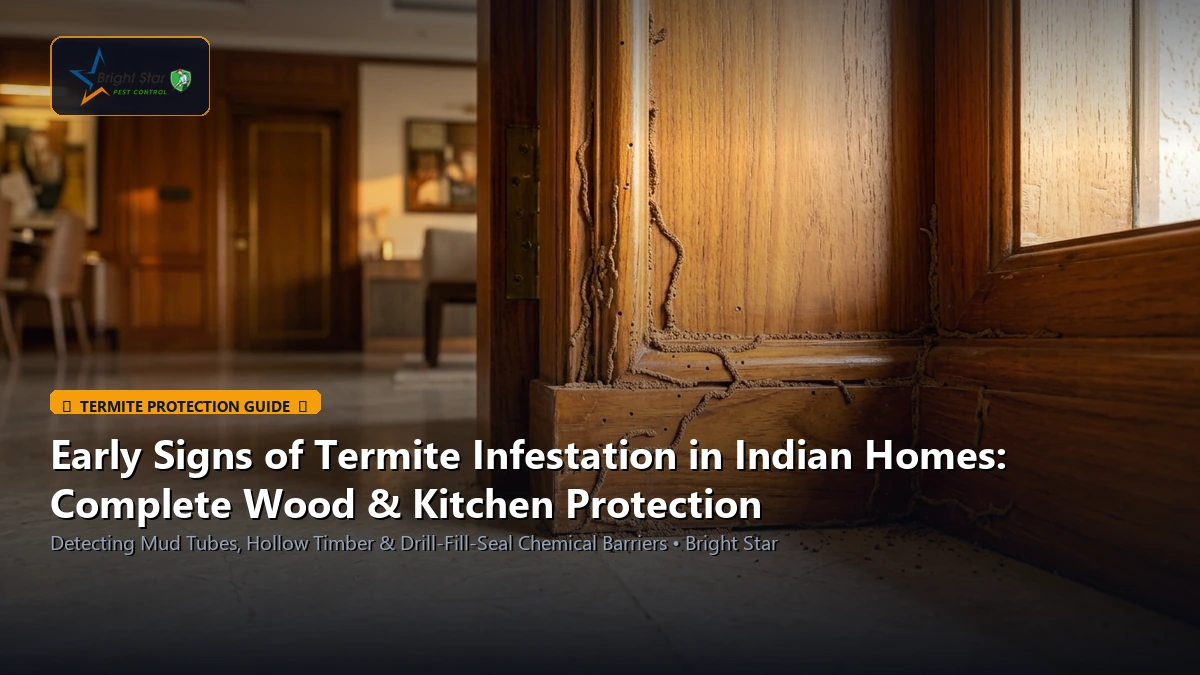
Termites, universally dreaded as deemak in India, represent one of the most silent yet financially catastrophic hazards facing contemporary homeowners. Across high-density urban areas like Delhi, Noida, Gurgaon, and the broader National Capital Region, residential apartments and independent villas alike suffer tens of crores of rupees in structural timber and interior decorative loss annually. Because subterranean termites feed exclusively on cellulose beneath the outer varnish of woodwork, an infestation typically remains invisible until the core of an expensive modular kitchen, flush door, or custom wardrobe has been reduced to fragile papery dust.
Understanding the early biological indicators of a subterranean termite presence, distinguishing them from wood borers or moisture seepage, and implementing certified chemical barrier protections can mean the difference between minor routine maintenance and a total interior renovation costing upwards of five to ten lakhs. In this comprehensive technical guide, the specialists at Bright Star Pest Control outline everything you need to know about early detection, anatomical clues, seasonal risk factors, and long-term warranty-backed chemical defense.
Why Indian Urban Homes Are Prime Targets for Subterranean Termites
There is a widespread misconception that termites only attack old ancestral bungalows or homes built on agricultural land. In modern multi-story apartment complexes across Delhi NCR, termites thrive for very specific structural reasons:
- Concealed Expansion Joints: Multi-story towers are constructed with foundation expansion joints and plumbing voids. Subterranean worker termites travel upwards through microscopic hairline foundation cracks as narrow as 0.5 millimeters to access upper-floor flats.
- High Usage of Engineered Woods: Modern interiors rely heavily on MDF (Medium-Density Fibreboard), commercial plywood, and particle boards. While treated teak or seasoned sal wood resists insects, unsealed porous plywood offers soft, moist cellulose that termites consume at exponential velocity.
- Hidden Plumbing Voids in Modular Kitchens: Under-sink RO filters, drainage pipes, and concealed dishwasher connections frequently produce ambient humidity. Termites require continuous moisture to survive; an enclosed, humid modular cabinet represents their ideal ecosystem.
- Warm Subtropical Climate: The prolonged warm seasons of Northern India provide optimal thermal conditions for subterranean termite reproductive cycles and colony expansion.
If you suspect an active pest problem or want a preventative diagnostic audit, exploring certified professional termite control services before installing or replacing wood furnishings is critical.
7 Early Warning Signs of Termite Activity in Your Home
Detecting termites requires moving beyond obvious surface destruction and learning to identify the subtle structural symptoms left by foraging worker castes.
1. Mud Tubes (Shelter Tubes) Along Skirting and Walls
Subterranean termites possess thin, delicate exoskeletons prone to fatal desiccation when exposed to open air. To travel between subterranean nesting soil and wooden food sources in your living room or kitchen, they construct pencil-thick earthen tunnels out of soil particles, saliva, and digested wood matter. Look for these distinctive brown, vein-like tracks crawling upward along skirting tiles, behind wall-mounted LED panels, inside electric meter boxes, or across the back panels of wardrobes.
2. Hollow or Papery Sounding Timber
Termites consume timber from the inside out, meticulously preserving a microscopic outer shell of laminate, polish, or paint to shield their colony from ambient light and drafts. Take the handle of a heavy screwdriver and gently tap along door jambs, wardrobe baseboards, and kitchen cabinet borders. A healthy wooden frame produces a firm, solid thud, whereas a compromised piece produces a distinctive hollow, drum-like echo.
3. Tight-Fitting Doors and Windows
When termites invade wooden door frames and windows, the moisture they transport into the structural core, combined with seasonal humidity, causes the timber to swell. If a bedroom door or bathroom casement suddenly begins sticking or becomes difficult to latch without any seasonal change in weather, check the hinge junctions immediately for mud tunnels or fine sawdust.
4. Discarded Swarmer Wings (Alates)
During the onset of warm or post-monsoon evenings, mature subterranean termite colonies produce winged reproductive alates that embark on nuptial flights to mate and establish new satellite colonies. These swarmers are attracted to indoor LED lights. Shortly after landing, they shed their delicate, translucent, equal-length wings. Finding small piles of discarded insect wings on window sills, balcony ledges, or beneath chandeliers is definitive evidence that an active mature colony exists within a fifty-meter radius.
5. Fine Exit Pinholes and Frass Deposits
Look closely at wallpapered accent walls, painted plasterboard, or polished wooden paneling for tiny circular pinholes no larger than the tip of a sewing needle. Termite workers puncture these tiny openings to eject fecal pellets and regulate nest humidity, quickly sealing them back up with small plugs of mud.
6. Frass Powder vs. Wood Borer Dust
Homeowners often confuse termite droppings with the fine powder left by powder-post beetles (wood borers). Termite droppings consist of microscopic granular pellets that feel gritty between fingers. In contrast, wood borers produce an exceptionally fine, silky, talcum-powder-like dust that continuously falls out of fresh pinholes onto floors.
7. Bubbling or Peeling Paint Mimicking Water Damage
When termites feed inside drywall or behind painted wood panels, the moisture trapped within their feeding galleries causes the exterior surface paint or wallpaper to blister, bubble, or peel. Many homeowners mistakenly call a waterproofing contractor to fix a peeling wall, only to discover that subterranean termites have entirely hollowed out the gypsum board beneath.
Notice Any of These Symptoms in Your Property?
Early detection stops deemak before your costly woodwork collapses. Bright Star Pest Control provides certified diagnostic audits across Delhi, Noida, and Gurgaon with advanced thermal acoustic wall scanners and long-term written warranties.
Book a Free Termite Inspection Or call our emergency helpline: +91-8882212218Comparison: Subterranean Termites vs. Wood Borers
Knowing exactly which timber pest has invaded your home determines the specific chemistry and application methodology required for permanent eradication:
| Diagnostic Parameter | Subterranean Termites (Deemak) | Wood Borers (Powder-Post Beetles) |
|---|---|---|
| Insect Classification | Isoptera (Social colony with queen, soldiers, workers) | Coleoptera (Wood-boring beetle larvae) |
| Primary Food Source | Cellulose from all wood species, books, drywall paper | Starch content inside sapwood of unseasoned timber |
| Powder / Residue Texture | Earthen mud tunnels and gritty fecal pellets | Extremely fine, silky flour-like yellow wood dust |
| Speed of Destruction | Extremely rapid (Massive multi-thousand worker colony) | Moderate to slow (Individual larvae tunneling inside wood) |
| Treatment Methodology | Drill-Fill-Seal non-repellent chemical barrier | Pressure injection of petroleum-solvent termiticides |
Why DIY Chemical Sprays and Kerosene Injections Always Fail
When homeowners spot mud tubes or discover deemak inside a kitchen cupboard, their immediate instinct is often to spray retail aerosol bug sprays, pump kerosene into the cracks, or brush surface wood preservatives. Pest control engineers emphasize that this approach almost always makes the infestation worse:
- Sensory Repellency Panic: Commercial retail aerosols contain synthetic pyrethroids that act as powerful sensory repellents. When sprayed directly on mud tubes, they kill the few hundred foraging workers on the surface, but immediately panic the central colony. The queen diverts the foraging workers into deeper, inaccessible structural areas such as internal wall conduits and false ceilings.
- Failure to Reach the Queen: A subterranean termite queen lives deep within an underground soil nest or central moisture pocket, laying thousands of eggs daily. Spraying surface woodwork has zero impact on the queen, allowing the colony to continue multiplying uninterrupted.
- Fire Hazard of Petroleum Solvents: Injecting kerosene or diesel into electrical switchboards and wooden framing creates an extreme fire risk inside residential apartments.
The Professional Drill-Fill-Seal Method: How True Eradication Works
To eliminate subterranean termites permanently, professional pest control companies employ the Bureau of Indian Standards (BIS 6313 Part 3) approved Drill-Fill-Seal chemical barrier method:
Step 1: Precision Diamond-Tipped Drilling
Certified technicians use specialized rotary hammer drills equipped with 12 mm diamond-tipped drill bits. Small holes are bored at downward 45-degree angles along the perimeter skirting of walls, door frame junctions, and built-in cabinetry bases at strict intervals of 12 inches (30 cm). In tiled rooms, technicians drill neatly along grout intersections to prevent cracking expensive Italian marble or vitrified tiles.
Step 2: High-Pressure Non-Repellent Chemical Injection
Using industrial pressure injectors, a specialized non-repellent termiticide emulsion, typically containing Imidacloprid 30.5% SC or Fipronil 2.92% EC, is pumped under pressure into the drilled cavities. Because modern termiticides are completely undetectable by termites, foraging workers travel directly through the treated zone without avoidance.
Step 3: The Lateral Colony Transfer Effect
As worker termites pass through the microscopic chemical molecules, the active ingredients adhere to their cuticles. When the contaminated workers return to the subterranean nest to groom their nestmates, feed the soldier caste, and nurse the queen through trophallaxis (mutual food exchange), the toxicant spreads systemically across the entire colony. Within 7 to 14 days, the queen and the entire nest collapse from within.
Step 4: Color-Matched Aesthetic Sealing
After deep chemical absorption, every single drill hole is sealed flush with high-grade white cement mixed with waterproof bonding agents and pigments color-matched to your floor tiles, restoring your interior aesthetics completely.
For detailed regional coverage and pricing structures across the capital, explore our specialized termite treatment in Delhi and dedicated service hubs in Noida termite defense and Gurgaon anti-termite management.
Proactive Tips to Make Your Home Termite-Resistant
In addition to scheduling regular professional inspections, homeowners can take specific architectural precautions to keep their interiors safe:
- Fix Plumbing Leaks Promptly: Check beneath bathroom vanities, kitchen sinks, and air conditioner drain pipes. Eliminating stagnant moisture removes the critical hydration termites need to survive indoors.
- Maintain a 2-Inch Gap Between Furniture and Walls: Avoid pushing heavy wooden wardrobes directly against external walls prone to dampness. Leaving a small air gap permits ventilation and allows early visual inspection.
- Pre-Treat Unfinished Wood Before Polishing: If constructing new modular furniture, apply an oil-based wood preservative primer to all rear, top, and bottom unlaminated plywood surfaces before installation.
- Inspect Wooden Storage Items: Old corrugated cardboard boxes, legal files, and stacks of newspapers stored on basement floors provide dense cellulose. Store essential paperwork inside sealed plastic containers instead.
Frequently Asked Questions About Termite Control
What is the best time of year to get termite control done in India?
Termite treatments can be performed effectively year-round. However, the pre-monsoon and post-monsoon months (March to May and September to November) represent peak periods when termite swarmers take flight to establish new colonies. Getting preventative treatment before seasonal humidity peaks ensures your wooden interiors remain protected.
Will drilling holes damage my expensive Italian marble or floor tiles?
No. Trained technicians use precision diamond masonry bits to drill at the tile-skirting grout line junctions, avoiding direct drilling into the center of tiles whenever possible. After chemical injection, the holes are sealed with color-matched waterproof epoxy or white cement, leaving the floor smooth, hygienic, and aesthetically seamless.
Are the chemicals used in modern termite control safe for children and pets?
Yes. Contemporary professional pest control services exclusively utilize Central Insecticides Board (CIB) registered, odorless water-based formulations like Imidacloprid. Unlike older organochlorine chemicals from decades ago, modern formulations emit zero toxic fumes, do not evaporate into indoor air, and remain safely locked inside structural cavities.
How long does a professional anti-termite treatment warranty last?
Bright Star Pest Control provides comprehensive written warranties ranging from 1 year to 5 years for post-construction treatments, and up to 10 years for pre-construction soil treatments. During the warranty period, any signs of termite re-infestation are re-treated completely free of charge.
How much does professional termite treatment cost in Delhi NCR?
The cost of anti-termite treatment depends on your property layout, carpet area (1 BHK, 2 BHK, 3 BHK, or independent villa), and whether treatment is preventative or corrective for an active infestation. Standard professional treatments start transparently from reasonable rates, backed by itemized quotations after a comprehensive site audit.
For more details on comprehensive multi-pest solutions, feel free to review our residential general pest control options, check out authentic customer reviews and testimonials, or contact our customer support team today.